On this page
There is no single figure for how much fat can liposuction remove, because the safe amount is individual and decided with your health as the priority. Liposuction is a contouring procedure, not a weight-loss method, so surgeons focus on shaping an area safely rather than removing as much as possible. Guidance often describes taking more than around five litres of fat and fluid as “large-volume” liposuction, which carries higher risks and additional precautions, but the right amount for you depends on your body and circumstances.
This article explains why there are limits, what determines the amount, and why liposuction is not a substitute for weight loss. It is general information and does not replace an individual assessment.
At a glance
- There is no fixed “maximum”; the safe amount is individual.
- Surgeons prioritise safety and contour over quantity removed.
- Removing large volumes carries higher risks and extra precautions.
- Liposuction is for shaping, not weight loss.
- Your health, the areas treated and your build all influence the amount.
Why there are limits
Removing fat also involves fluid shifts and some blood loss, and the more that is removed, the greater the physiological demand on the body. Taking too much in one procedure can increase risks such as fluid imbalance and a more difficult recovery. For this reason, surgeons work within safe limits and may stage treatment across more than one session if a lot needs addressing. Safety always comes before the amount removed.
What determines how much can be removed
Several factors influence the amount that is safe and sensible in your case:
- Your general health: underlying conditions affect what is safe.
- The areas treated: different sites hold different amounts of fat.
- Your body size and composition: these affect both goals and safety.
- Whether other procedures are combined: this can influence limits.
- The setting and aftercare available: larger volumes need closer monitoring.
Your surgeon weighs these together. Our risks and recovery resource covers safety considerations in more detail.
Large-volume liposuction
When more than around five litres is removed, this is often termed large-volume liposuction and is treated with extra caution, sometimes requiring an overnight stay and closer monitoring. This threshold is a general guide rather than a target, and the appropriate amount for you is decided individually. A responsible surgeon will not remove more than is safe simply to achieve a bigger change.
Why liposuction is not weight loss
Liposuction removes a limited volume of fat to reshape specific areas; it is not a treatment for being overweight and is not a substitute for diet, exercise or medical weight management. People at or near a stable, healthy weight with localised stubborn fat tend to be the best candidates. Our guide on whether plastic surgery is right for me may help you consider your goals, and our liposuction page explains the procedure.
Risks and limitations
Liposuction carries risks including bruising, swelling, contour irregularities, changes in sensation, asymmetry, fluid collections and, less commonly, infection or blood clots, with risks increasing as the volume removed rises. Results cannot be guaranteed, and remaining fat can enlarge with weight gain. Your surgeon will explain the risks relevant to the areas and volume you are considering.
Is liposuction right for you?
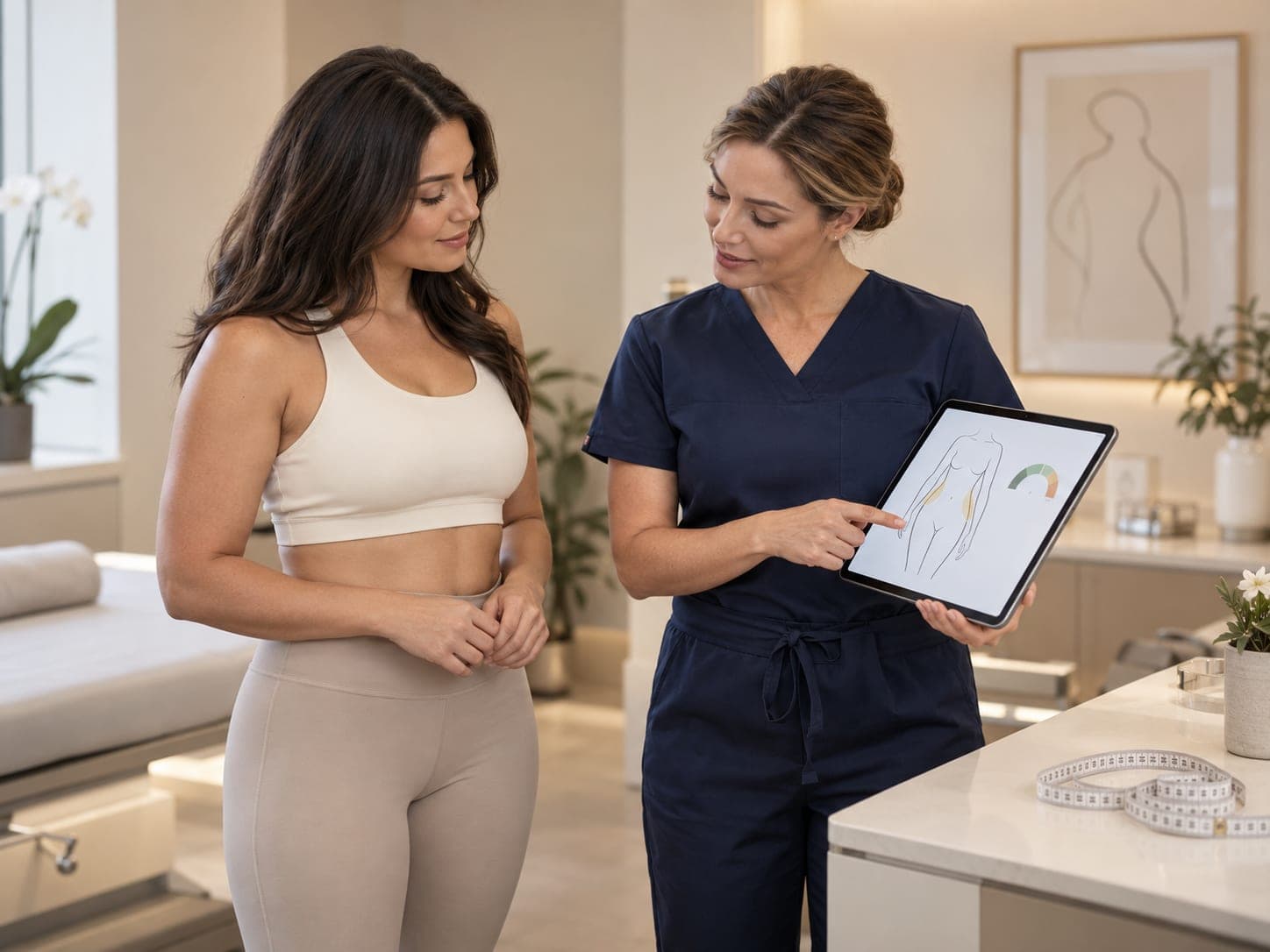
Whether liposuction suits you, and how much can safely be removed, depend on your health, goals and an individual assessment. A consultation allows your surgeon to examine you and give a realistic, safe plan rather than a fixed figure.
Why it is about contour, not the number
It is easy to focus on how many litres might be removed, but a good liposuction result is judged by the shape and balance achieved, not by a figure. Removing a large amount does not necessarily produce a better outcome, and pushing beyond safe limits can lead to contour irregularities, a more difficult recovery and higher risk. Skilled contouring is about removing the right fat from the right places to suit your body.
Skin quality also matters. Where skin has good elasticity, it can shrink back after fat is removed, giving a smooth result; where it does not, removing a lot of fat may leave loose skin. This is another reason surgeons plan around your individual anatomy rather than a target volume. Keeping the focus on a natural, proportionate shape, and on safety, tends to give the most satisfying and durable results, which is why a personalised plan matters more than any headline number.
Understanding how much fat liposuction can remove
How much fat can liposuction remove is always an individual judgement, made with safety as the priority, and it is not a weight-loss solution. Rather than aiming for a maximum, surgeons focus on a safe, natural contour suited to your body. A personal assessment is the only reliable way to know what is appropriate for you, and you are welcome to arrange a consultation to discuss it.
Frequently asked questions
How much fat can be removed with liposuction?
There is no fixed maximum; the safe amount is individual. Removing more than around five litres is often termed large-volume liposuction and carries higher risks and extra precautions.
Is liposuction a way to lose weight?
No. It is a contouring procedure for localised stubborn fat, not a weight-loss method, and works best for people at a stable, healthy weight.
Why won’t a surgeon just remove as much as possible?
Because removing large volumes increases risks such as fluid imbalance. Surgeons prioritise safety and a natural contour over quantity.
Can treatment be split into stages?
Yes. If a lot needs addressing, a surgeon may stage treatment across more than one session to keep it safe.
Will the fat come back?
Fat cells removed from an area do not return, but remaining fat cells can enlarge with weight gain, so a stable weight helps preserve results.
This article is for general information only and does not replace personalised medical advice. Results vary between individuals, cannot be guaranteed, and all surgery carries risks. Suitability can only be determined through an individual consultation with a qualified surgeon.